Showing posts with label novel. Show all posts

Tuesday, 7 December 2010

Going postal in 60’s L.A.

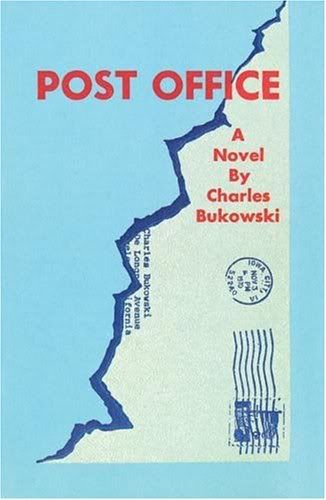
post office Bukowski Pictures, Images and Photos

Based on the recommendation of a friend I’ve just finished reading the novel Post Office by American author and poet Charles Bukowski.

This was an interesting book for me as it was well out of my comfort zone and not the sort of thing I’d usually go for. For a start, there’s no real story, just a collection of fairly random events covering over a decade in the life of Bukowski’s close-to-home alter ego Henry Chinaski. Chinaski is an alcoholic, womanising, gambling low life who aimlessly lurches from one menial job to another before ending up working for the US Postal Service where he remains for eleven years stuck in the soul destroying limbo of brain dead and degrading work. According to Chinaski the Post Office is a place populated by all kinds of annoying, repulsive loudmouths, dictatorial jobs worth managers and other assorted broken and downtrodden characters. Chinaski survives the place and his years spent there through copious amounts of booze, women, and his extremely cynical view of the world. To note: the term going postal comes from the fact that in the past quite a few US postal workers have snapped and done the whole workplace murder spree thing. Reading this you can see how that could happen.

After a slow and wary start, and after putting it down for a few weeks due to not really feeling the vibe of the thing, I persisted and picked the book back up a couple of days ago. And for some reason I got in to it a lot more this time and finished off the remaining hundred or so pages pretty quickly (it’s only one hundred and sixty pages in total so is more of a novelette than a novel). And I gotta say...I enjoyed it a fair bit. It’s still not really my cup of tea but it is an interesting look in to a life totally alien and in to the world of sixties America - specifically Los Angeles when many of the riots were kicking off. But even though Chinaski’s sort of life is alien to me, I could still kind of identify with some aspects of it such as the sheer drudgery and boredom of menial work and the attitudes of some of those little Hitler types who when they get the slightest whiff of power just love to make others life hell. Luckily I haven’t had too much experience of that, but I have had some, just as many surely have. So you can’t help but smile and give a silent cheer when Chinaski, through his cynical wit, or a small act of defiance, gets one up on em and on the system.

Stylewise, Bukowski’s writing is refreshingly basic, unfussy and to the point. Description is brief and limited and mostly focuses around the size and shape of women or the things he particularly dislikes about a person or a place. Sentences are short and dialogue dominates. And that dialogue is usually dry, cynical and bleakly humorous. And it does make you laugh. Bukowski constructs short, punchy, (oft dark) comic set pieces throughout. The one about the two birds Chinaski’s wife keeps in a cage that keep him awake with their incessant chatter and then what he decides to do with them is particularly funny.

Post Office was Bukowski’s first novel. It was released in 1971 and is said to be an autobiographical account of the writers own experience working on and off for the US Postal Service. Bukowski was quite a fascinating character. He became a willing alcoholic from his early teens saying that it helped him overcome his chronic social ineptness and withdrawn nature. Arguably it also helped fuel his writing ability giving him that extra dimension through which to tell his low life tales and to impart his poetry. The alcohol did harm to him for sure (bleeding ulcers and other complaints) as well as hindering him socially as much as he thought it helped him. But the argument that says how drugs and booze have helped form some of the greatest art, literature and music through the ages could be applied. For without the booze, Bukowski would probably not have become the renowned and influential writer he did. He died in 1994 from Leukaemia aged 74.

I may go on and read some more of his stuff, the continuing saga of Henry Chinaski in the likes of Ham on Rye, Factotum and Women. But the relentless low life, cynical (though amusing) gloom might be too much to take in extended doses. So I think I’ll leave it for a while. As a total antithesis to Bukowski I’m currently reading the official 2009 sequel to the wonderful A Little Princess entitled Wishing for Tomorrow by Hilary McKay. Then it’ll be Stephen King’s Cell, all being interspersed by the odd Edgar Allan Poe poem and short story. Some nicely eclectic reading over the Christmas period.

Monday, 26 April 2010

Swedish Zombies Go For The Heart


I recently finished Handling the Undead, Swedish author John Ajvide Lindqvist’s acclaimed follow up to Let The Right One In. Handling the Undead is actually several years old now and has only recently been published in the UK (on the back of the LTROI movie success.) It first saw light in Sweden back in 2005 but it took four years for the English translation to appear. Never mind. Better late than never I guess.

The story goes something like this:

For some inexplicable reason the recently deceased of Stockholm (those dead for up to six months) have come back to life. This includes all those who have been buried as well as those previously undiscovered bodies including, in one memorable incident, a man who had drowned in a lake and whose body had been hidden beneath the water for weeks. Needless to say he is not in a good state when he wakes up. But these ‘reliving’ are not quite the people they once were. There are aspects that are familiar but they seem to be more robotic and instinctual. And they also appear to have a strange psychic effect on regular living people whenever they come together in any number. The book focuses equally on several main characters and how they each deal with the reappearance of their recently departed. There is David, a stand up comic, whose wife was killed in a car crash the same night as the mass resurrection and who has been left to care for his young son. Meanwhile, teenage metaller, Flora, and her Catholic grandmother, Elvy, are horrified when the reanimated corpse of Flora’s granddad, Elvy’s husband, arrives at their front door. And then there’s middle-aged journalist Mahler who, upon discovering what has happened, goes to the local cemetery and digs up the reliving body of his young grandson Elias who recently died in a tragic accident.

Now, a lot of this is pretty grim stuff, especially everything to do with little Elias. The little boy is a dried up corpse, yet he is also reliving. Mahler and his grief-struck daughter’s continual and rather hopeless attempts to help Elias appear and to act more human by bathing him, moistening his desiccated skin with lotion and training him to react to simple things, is difficult stuff to read. Lindqvist’s prose is simple but very descriptive and highly emotional. He doesn’t shy away from intense imagery that will make you feel rather queasy. But even so, Handling the Undead is not really a horror story. Rather it is a grim, sad fable about life and the meaning of death. It is about how people deal with death, how they rationalise it, live with it, make it in to something else through the use of religion or even make it in to entertainment using more modern cultural outlets like movies and video games. The novel’s reliving are quite similar to the classic Romero zombie in that they shuffle around and many are in a very bad way, but they don’t eat people as their Hollywood cousins do. Lindqvist uses zombie films and video games such as Resident Evil (which shows up a lot in the story) as the touchstone for how people, mostly younger people, relate to the reliving, how they dehumanise them even though there is still a spark of their humanity remaining. The book follows several groups of characters and the emotional, psychological and actual physical journeys they go on in dealing with the return of their loved ones and of the wider event. This is not a story about plot twists and turns. It is a story about people, their emotions and how they deal. Or don’t deal. It is a journey of grief, faith and eventual acceptance. There is no big climax, no big revelations. The ending is like the rest of the book: quiet, sad and emotional.

There is no doubt that Handling the Undead is a good book. It is well written, atmospheric and quite disturbing in places. However, as with Lindqvist’s Let The Right One In, I found that the story, though compelling, meandered a little too much for my taste. There are many scenes where nothing much really happens, scenes that seem to just go off to places I wasn't really that interested in them going, wishing Lindqvist would just cut back to the central idea and perhaps focus more on some fewer characters. The wonderful thing about the film of Let The Right One In is how Lindqvist (who also wrote its screenplay) pared down his book to the core story and theme. He jettisoned the subplots and the excess fat from the book with the result being that the film was a superior telling of the story than the book it was based on. Don’t get me wrong, Handling the Undead is certainly a good book with an interesting and thought provoking approach to the zombie genre. I did like it. But if only it had been rather more focussed then it could have been a classic.

Sunday, 14 March 2010

A Legendary Book


I am Legend (Richard Matheson, 1954)

This month I finally got around to reading Richard Matheson’s 1954 sci-fi/horror classic I am Legend. It’s one of those books I’ve been meaning to read for years as it’s had such a major impact on modern sci-fi and horror movies and literature. I’ve seen the three films based on it - The Last Man on Earth (1964) starring Vincent Price, The Omega Man (1971) with Charlton Heston and, of course, I am Legend (2007) starring The Fresh Prince and a dog. Even before reading the book I didn’t much like any of these films with the exception of The Last Man on Earth, which, though very low budget, at least seemed faithful and starred the great Vincent Price. I really do hate The Omega Man what with its trippy albino hippies while I am Legend is a decent enough blockbuster vehicle for Will Smith but I knew even before reading the book that it missed the whole point of Matheson’s story by going all CGI Hollywood on us.

For those who don’t know the story of the book, it goes like this:

A plague has swept across the world killing most of humanity and turning them in to vampires. The ones it has infected but who haven’t died have also become vampires. As such the main character Robert Neville appears to be the last human left on Earth.

Neville spends his days out of his fortress house gathering supplies and finding the living and the dead vampires and staking them for a final death. By night he holds up under siege from a horde of bloodsuckers led by one time neighbour Ben Cortman who desperately wants to get at Neville, hurling abuse and taunts at his home guarded by garlic and crosses – all of which seeming to work in the traditional way. Neville has lost his wife and young daughter to the plague and so spends a great deal of time in depression and in heavy drinking. His loneliness is always threatening to destroy him faster than any vampire could. He spends a couple of years this way until he eventually discovers a new mission and point to his life. He decides to learn about diseases and germs and sets out to discover the true source of the vampire plague. He also wants to find out how come all the traditional vampire lore seems to be true – sunlight killing them, fear of crosses, repelled by garlic, unable to cross running water, killed by a stake through the heart. And, of course, how come he alone seems immune.

I am Legend is a fascinating tale that works on several levels.

Firstly, it takes the familiar folklore of vampirism and treats it as a disease; a natural based condition rather than a supernatural one. Over time, Neville does indeed identify the cause of the plague and discover the scientific based reasons for all the familiar vampire attributes. Some of which are surprising but do make a weird kind of sense and are backed up by reasoned arguments. To my knowledge this is probably the first time this approach to vampires was ever taken. Nowadays we see it a lot with the likes of Blade, Ultraviolet, Underworld and the recent Daybreakers, that last one owing a huge debt to Matheson.

Secondly, the book works as a character study. It’s a dark and tragic tale of loneliness, isolation, guilt and regret. Neville feels constant guilt over the death of his wife, Virginia, whom he loved intensely. We see some of their life together in flashback including when she first became ill. And we also see in flashback the horrific night where she comes back to him as a vampire and what he then had to do. Neville of course feels guilty about having had to kill Virginia as a vampire, but more so about having survived the plague while she didn’t. Throughout the book he is constantly talking to her, either out loud or in his mind, saying things like “I’ll be with you soon, Virge.” Neville often falls in to deep depressions, losing track of time and of himself, resulting in sudden mortal dangers such as being caught outside for too long as the sun falls and the vampires come out to hunt. He is also constantly reminded of his old life by the nightly appearance and taunting from his old friend and neighbour Ben Cortman. One of the most interesting things in the book is the sexual nature of Neville’s guilt. Because he is all alone and still has the normal male urges, he finds himself aroused by the female vampires who come out at night and display themselves to him, trying to lure him to them. This is a familiar theme in vampire stories: the sexual undercurrent including dangerous sexual temptation. And Neville hates himself for the thoughts that go through his head and the reaction his body has to their offered flesh. More than once he almost gives in and goes to them, but manages to pull back at the last moment.

Thirdly, I am Legend works as a morality tale. A fable about ones place in the world. About seeing the wider view and not giving in to mindless fear and prejudice, about trying not to become that which you despise the most. For it eventually becomes apparent to Neville that the world has changed forever. There is no going back. Humanity as he knew it has gone, with a new species now born in its stead. A species that is trying to carve out a new society from the ruins of the old. But one thing stands in their way. The one who murders their kind by day, slaying loved ones – mothers, fathers, husbands, wives, children. The object of their fear and hate, the bogeyman that comes for them while they sleep. There is only one way this story can end.

I am Legend is a great book, a justifiable classic. It is short (180 pages), simply told, lightly plotted, yet dense with ideas and character. Neville is an everyman. He is not a soldier or scientist or whatnot. He is smart and resourceful, sure, but he also has to learn about things to survive and progress. He spends years learning about diseases and germs so he can try and work out what happened to the world. Even then he gets things wrong.

Having now read the book, the Vincent Price movie is by far the closest in terms of plot and themes. The Will Smith one is pretty far removed and it irks me even more that they took a book full of such great ideas and a brilliant and challenging central one (which is the entire point of the book’s title) and discarded it in favour of standard Hollywood heroics. They entirely missed the point of Matheson’s story. Twats! Reading I am Legend I couldn’t help but think that back in his heyday John Carpenter could have made a wicked film out of it. Shame he didn’t get the chance.

But if you ever get the chance, then pick up a copy and read it. It’s a seminal work. It’s the stuff of legend.

Next up on my book pile is Handling the Undead, Swedish writer John Ajvide Lindqvist’s follow up to his excellent Let the Right One In.

Sunday, 14 February 2010

Some tales never grow old...

dorian,gray,movie,ben,barnes,colin,firth
Dorian Gray stars Colin Firth (A Single Man) with Ben Barnes (Prince Caspian) in the title role and is based upon the 1890 novel The Picture of Dorian Gray by Oscar Wilde.

The film tells the tale of a young man, Dorian Gray, who comes to London after inheriting his family estate. He is naive and innocent and also exceptionally attractive and charismatic yet unaware of the effect he can have on people. Dorian is taken under the wing of Lord Henry Wotton who imbues the impressionable young man with his own hedonistic worldview: the unfettered guilt free pursuit of pleasure. At the same time Dorian has his portrait painted by Basil Hallward, a talented artist who has become besotted with his young model. Dorian succumbs to Lord Henry’s temptations of unadulterated pleasure seeking and enjoys himself so much he makes an unwitting Faustian pact to always keep what according to Sir Henry are “the only two things in life that mean anything…youth and beauty.” And so begins a story of corruption, vanity, morality and murder that ultimately leads to Sir Henry having to confront the monster that he has made to protect his grown up daughter who, now twenty years later, has fallen for the still youthful Dorian just returned from years spent travelling.

I’ve never read Wilde’s novel nor seen any of the previous adaptations (except for Stuart Townsend in The League of Extraordinary Gentlemen) but I was familiar with the story as I expect many are. It is a classic fable of corrupted youth, of unhinged vanity and absent morality. I’m told by people who know that this film version directed by Oliver Parker remains pretty faithful to Wilde’s original novel and its themes. It certainly shows the overt and quite graphic sexuality that Wilde had to tone down in his revised 1891 edition. The film is handsomely mounted with convincing art direction and very fine cinematography by the great Roger Pratt (Brazil, Batman, The Fisher King, Chocolat, Harry Potter.) The use of subtle digital effects to recreate Victorian London also works well as they do in creating Dorian’s monstrous true self. In the title role Ben Barnes looks the part and does a reasonable job in showing the transformation of a young innocent who gradually strips away all conscience and morality to begin enjoying the wild times, before, many years later, realising he is living a hollow, haunted, pointless life. Barnes is okay, but to me he doesn’t have the charisma to make you believe that all these men and women would be so easily in awe of him. On the other hand, Colin Firth, an actor I’ve never really cared for, is excellent as the corrupting older man/monster maker who ultimately comes to realise what he has created when his own daughter falls under Dorian’s spell. They are well supported by a strong cast including Rachel Hurd-Wood, Ben Chaplin and one time Bond girl Maryam D’Abo. Parker directs in an unflashy manner just telling the story through the actors and the solid script using no great flourishes of style, which is a smart move. Wilde’s brilliant story simply doesn’t need any flash, as such things would only detract from its power.

Watching Dorian Gray I was reminded a great deal of Interview with the Vampire, one of my fave books and films. I wouldn’t be surprised if Anne Rice is a fan as they share many of the same themes. The attraction of eternal youth and beauty and its almost hypnotic power over others, the deliberate moral corruption of another, the idea of freedom being achieved when released from conscience, guilt and consequence. The eventual hollowness, loneliness, stagnation of never changing or growing. And the ultimate realisation of the price that has to be paid for ones actions and decisions. For there is always a price to be paid sooner or later. And then of course there is the strong homoerotic subtext in both works with Dorian Gray’s being rather more overt – at least in this version.

A solid, good looking, entertaining fable with strong production values and a simply brilliant story to tell, Dorian Gray is worth seeking out even though you won’t be quite as entranced by his power as you should be.

Tuesday, 12 January 2010

The (not so) Lovely Bones

Susie Salmon


Hmmm…

I read the book last year. Though not the best written of works it does have a huge visceral and emotional impact and its themes are strong and affecting. Strangely, apart from a few individual scenes and moments, this film adaptation lacks in both impact and thematic resonance.

Peter Jackson's film of Alice Sebold's The Lovely Bones has been somewhat sanitised for movie audiences and seems happy to just fall back on sentimentality and overblown FX. What should have been an uncomfortable, heartbreaking, uplifting but – important this – a subtle story comes across as a well produced yet rather hollow melodrama with decent actors and lots of very expensive CGI.

To be honest I’m not really sure what the film of The Lovely Bones was really about or what the point of it was. I suppose it plays best as a coming of age tale as it does retain elements of the coming of age story in the book, based around young Susie Salmon’s yearning for her first boyfriend and her need to grow up, even after her cruel death. In the book she had a first kiss but it never progressed further. After her death she yearned to make love to the boy she loved – especially as in the book (but not in the film) she is horribly violated before being murdered. And that hideous act can’t be her one and only experience of sex. Basically she needed to grow up to be able to move on. But in the film this is over simplified to be all about that one first kiss. The emotional journey of Susie is completed using the same method as in the book only it is now lacking in any real weight and feels kind of rushed and rather awkward. And the characters it happens to in the film are not developed at all so we have no real sense of who they are or of their relationship to each other and of the importance to them of what Susie is doing through them. By ‘the characters’ I mean Ruth Connors, the rather odd, outsider girl from Susie’s school who loves art and poetry and has the ability to sense and sometimes see the dead, and Ray Singh, the handsome Indian/English boy who was Susie’s should-have-been boyfriend. In the book, Ruth and Ray come together and form a close and complex friendship based around Susie’s memory – even though Ruth never knew her very well. In the film this coming together and relationship isn’t developed at all. They chat briefly…and that’s it. Ruth especially is a major character from the book and yet she has only a few brief lines here.

The other major theme of the book is about family. How families can come together and also fall apart. But ultimately how life goes on, and, despite the terrible things that can happen, wonderful things will happen too. In the book a lot of time and attention is paid to the dynamics of the Salmon family and how Susie’s murder affects them all, how it starts to pull the family unit apart but also how her memory ultimately brings them back together with new happiness and love. In the film this theme is skimmed over at best with the positives being reduced to a few shots at the end over Susie’s last voiceover. Basically lip service is paid to the main themes of the book leaving the film feeling rather hollow and lacking. I know that in adapting a book to a film you need to cut away lots of stuff and move stuff around and focus your story more. But when doing that removes much of the point of the story then why bother? So in Peter Jackson’s film we get the pared down, straightforward story of fourteen year old Susie (Saoirse Ronan) being murdered, who then goes to ‘the in-between’ and runs around CGI hills and beaches, yearning for her aborted first kiss with Ray Singh while also watching her dad Jack (Mark Wahlberg) smash up his ships in bottles and obsess about finding her killer. Yep, bare bones of the book and rather unfulfilling. It is odd that Jackson, his wife Fran Walsh together with Phillipa Boyens who between them did such a grand and masterful job adapting the huge Lord of the Rings seem to have dropped the ball with a smaller more intimate tale.

Now, having been rather harsh, this is still a Peter Jackson film. And as a Peter Jackson film The Lovely Bones is technically very well made with certain sequences, scenes and moments being excellent and hitting their targets bang on. The entirety of the sequence in the cornfield with Susie being enticed by George Harvey and then meeting her end at his hands (which we don’t thankfully see) is beautifully directed and acted. You sit there watching it, knowing what is coming, saying to yourself ‘Please…just turn around and run home, Susie.’ Apart from the rape, which doesn’t happen anyway in the movie, and the murder itself, this sequence looks and feels just like how it was described in the book. Then there is Susie’s dad smashing up his ships in bottles and then seeing the strange candlelight reflection in the window. That was genuinely moving. As was the afterlife sequence where Susie realises the true horror of Harvey’s crimes. The sequence where Susie’s little sister Lindsey breaks in to Harvey’s house is also straight from the book and is handled very well. It is supremely tense and creepy.

And so what of the cast? Casting the central role of young Susie Salmon was pivotal to this film. You have to get from Susie innocence combined with genuine rage and sadness for everything she has lost and will never have. She is smart but not especially so. Sister Lindsey is the really bright one who excels at school and at sports. Susie is just a normal teenage girl full of conflicting emotions and bubbling hormones, trying to become a woman and yet still childlike in many of her ways. As Susie, Saoirse Ronan is good. She is not great – but then she is not given especially great material to work with and has probably been directed in an ill-advised manner on occasion. The main culprit for this is in the over sickly and breathy voiceovers. They should have sounded more subtle, mature and wise in their speaking. Instead they are rather overwrought and theatrical. But she is certainly a good actress and with her long limbs and huge emotive blue eyes she looks striking and sells her scenes well enough. Mark Wahlberg as Susie’s dad Jack is good too. It is a low key and understated performance. He is not required to do much except be a nice, quiet chap before later on getting bleary eyed and quietly heartbroken. And Marky Mark does fine. He is believable as a father who has lost the brightest thing in his life. His steady, low-key, unyielding obsession over finding Susie’s killer is played nicely. Rachel Wiesz as Susie’s mum Abigail sadly makes no impact at all. She plays a tiny role in the film and disappears for a large section. Her entire backstory and subplot has been removed. Susan Sarandon as Grandma Lynn is good fun as the comic relief – even more so here than in the book. And then there is Stanley Tucci as George Harvey, the Salmon’s neighbour and the killer of Susie. He is the standout in the film and is very good indeed. Perhaps too good. Tucci is instantly creepy and repulsive as the loner, dollhouse building Harvey. But to be fair that was the character from the book. Almost everyone in the book thought Harvey was odd and creepy with that being the main factor why Jack and his daughter Lindsey suspected him of Susie’s death. And Tucci is certainly good at being bad. Harvey is a genuine monster whose monstrous deeds and compulsions become further revealed towards films end. His manner is reptilian and his methods disgustingly well thought out and planned. You really hope he gets what’s coming to him. Nobody else in the film makes any impact. Ruth and Ray who should have been main characters are sidelined. The actors look the part and say their few lines well enough. But that’s it.

In the end The Lovely Bones is rather a disappointment for me. It is far from a bad film, though. Peter Jackson just seems to have missed much of the point of the story. And while certain parts are handled beautifully and will give your tear ducts a good testing, he has also misjudged or simply missed out things that would give this story the genuine overall impact that it deserves. To my mind the film he made is too overblown, sanitised and over-reliant on flashy CGI. It feels oddly hollow at its core and is lacking in an overall emotional connection while appearing rather muddled in what it is trying to do and/or say. And yet, despite its shortcomings, I still kinda like it…mainly for the scenes and moments Jackson gets dead right. For example Ray telling Susie, “You are beautiful, Susie Salmon.” Grandma Lynn telling Susie about first kisses, saying, “Just have fun, kid.” Ruth seeing Susie’s spirit rush past her in the night. The candle’s ghostly flickering in Susie’s dad’s window. The reveal of the extent of Harvey’s monstrous crimes and the following sad-yet-happy realisation by Susie that she is not alone. And the lovely final words and good wishes Susie gives to us the audience before the screen grows dark. A good film in parts then, but not really one that works as a whole. This is no Heavenly Creatures and certainly no Lord of the Rings. And that’s a real shame.

.

Friday, 18 December 2009

Lonely Werewolf Girl


I’ve just finished reading Lonely Werewolf Girl, an off beat, very funny, hugely entertaining book by Scottish author Martin Millar.

This is a most excellent novel. It’s a darkly humorous tale with a strong story and a big cast of characters who are just so much fun to follow through its five hundred and twenty pages. These people feel fully rounded with their own distinctive voices and attitudes and complex sets of problems and issues. The tone, for the most part, is darkly humorous with monsters, magic, mayhem, horror and violence mixed in with the normal everyday of work, study, failed romance, endless mugs of tea, going to gigs, going to the pub, watching cable TV, listening to and talking about music. The book feels leftfield and more than a little punk in attitude with non-conformist outsider characters that end up coming together in uneasy, difficult yet ultimately beneficial relationships. It is also, quite simply, very, very funny. I laughed out loud a lot while reading Lonely Werewolf Girl. As a total coincidence I found out after the fact that author Martin Millar is a massive Buffy geek…just like me. And Lonely Werewolf Girl does have a bit of that Buffy vibe about it – the tonal shifts in the mix of action, then quirky/dry humour, then horror, then emotional drama and often all in the space of the same scene and always with an underlying theme. But it’s not a copy or homage to the Bufster. It is most definitely its own thing with its own voice. And a mighty fine voice it is too.

The central plot hinges on a family power struggle as to who will be the next Thane of the Scottish MacRinnalch werewolf clan - basically becoming leader of all werewolves in the world. The eldest son, Sarapen MacRinnalch, thinks the title is his by right, whilst his mother, Verasa, will do whatever she can to make Markus, her younger, favoured son, the new Thane…even if it means a bloody civil war. Votes are needed at the clan council to secure the victor, to secure the new Thane legally. However, things are at a stalemate as the three members of the clan with the likely deciding votes are not around to cast them. Two of the three being the young rebellious twins Beauty and Delicious who are living a drunken hedonistic life in London while half-heartedly trying to become rock stars. The third voter is Sarapen and Markus's youngest sister, seventeen year old Kalix. Kalix, the titular Lonely Werewolf Girl, ran away from Castle MacRinnalch several months prior after attacking her father and indirectly causing his later death. Poor Kalix is a deeply troubled girl. Living rough in London, she’s lost and alone and can barely read a few words or write her own name. She suffers from extreme depression and anxiety while also being addicted to laudanum. Despite continually running away from everything and everyone, events soon conspire to throw Kalix together with two kind-hearted young students whom, by taking pity of her, become unwittingly embroiled in the complex and deadly werewolf world. And big bad Sarapen’s forces are on the move in London and Scotland. He's determined to eliminate any and all obstacles to his becoming Thane. And young Kalix is right at the top of the list.

It has to be said that Kalix is a brilliant character. The best I’ve read in a long time. You can’t help but feel for her and just want her to be happy. She lives her life on the streets, ostracised by her family, swinging from extreme anxiety to extreme depression with substance abuse (mostly laudanum) and self-harm being her main ways of handling things. She is also affectingly innocent in her ways with a very sweet, longstanding obsession with the 1970’s girl group The Runaways. Kalix believes them to be the greatest thing ever and longs for Joan Jett to be her real mother. Later on she also develops an addiction to Sabrina the Teenage Witch but can’t understand why such a great show isn’t on the TV all the time and why they keep repeating the same episodes when there should be an endless supply of new ones. Yet, despite her problems and naivety, Kalix is a ferocious and powerful fighter who, when the battle madness takes her, can tear apart other werewolves and werewolf hunters more than twice her size as if they were nothing.

A couple of funny quotes from the brilliantly hilarious, fashion obsessed Malveria, the powerful Fire Queen from another dimension:

"Their blood-soaked bodies are no doubt strewn about downstairs at this moment!" cried Malveria. "If we hurry we may save the shoes!"

"That is it. Cricket. Apparently the rules of this game are most puzzling and complex. Daniel tried to explain these rules to Vex. As a consequence of this I understand she almost lost consciousness, and had to be helped to a chair, in a very poor state of mind. It was some time before she could summon enough energy to return to her own dimension. She has subsequently refused to leave her room, and has only her favourite cuddly toy for comfort."


Bottom line: this is a great book by a gifted writer who can weave a big, complex tale with a myriad of distinct and interesting characters while juggling drama, action and humour exactly right. So if you like urban fantasy/horror with a smart, blackly hilarious and counter culture feel, then you should love this book. Martin Millar is currently working on the sequel tentatively titled Queen Vex and due out late 2010. And a Lonely Werewolf Girl movie is apparently in the works too.