
Showing posts with label sci fi. Show all posts
Showing posts with label sci fi. Show all posts
Sunday, 26 December 2010
What the Dickens? Doctor Who: A Christmas Carol
And so it came to pass that Steven (The Moff) Moffat did make the most Christmassy Doctor Who ever…and he was not ashamed one bit.
Moffat’s A Christmas Carol is a gloriously bonkers, clever, weird, hilarious, magical and sweetly sentimental affair that instantly adds itself to the collection of best interpretations of Dickens classic - my personal favourite still being the Muppets untouchable 1992 film.
We are all familiar with the basics of this timeless tale so I won’t go in to any great detail of the plot. Suffice to say The Doctor takes on the role of ghost of Christmas past by attempting to change the ways of a miserly old Scrooge-like figure (Michael Gambon) in order to save four thousand people (including Amy and Rory) on a doomed ship about to crash in to a planet. A planet that looks a lot like a Victorian steampunk London. Along the way we get fish in fog, scary sharks, frozen people, Marilyn Monroe and Frank Sinatra, a beautiful welsh singer who actually can act, and lots and lots of Moffat’s favourite timey wimey cleverness all bound together in to a tender love story and classic moral fable.
Look, I don’t care what anyone says, Matt Smith as The Doctor is just so damn good. He owns the role completely. Doubters be gone. His impishly eccentric yet also playfully subtle childlike/old man portrayal is pure genius. Somehow he never seems to take it too far as I felt Tennant sometimes could. And as for Katherine Jenkins as Abigail… Well, the term angelic doesn’t quite do her justice. I’ve never really seen much of her before apart from in brief interviews and photos. Of course she is incredibly beautiful and when I did see her in interviews she always came across as a genuine and sweet natured person. And thankfully that comes across on screen in her acting. And then some. Sure, she wasn’t exactly being stretched in the acting stakes here, but what she had to do as Abigail she did incredibly well. A lovely and luminous presence. And so what of Michael Gambon? Well, what can you say? The man is a legend and is, of course, brilliant in every scene.
The behind the camera team are on top form here as well. Major kudos must go to director Toby Haynes and to the design, art direction and photography - all wonderfully evocative and atmospheric - especially the design and execution of the Victorian steam punk city. Also, added kudos too to Murray Gold for his sterling musical work. The really quite beautiful end song he wrote and that Katherine sang (see YouTube clip above) was so goose pimple-raising good it deserves to be released by the BBC, ideally for charity.
Anyway, I absolutely loved A Christmas Carol. Sure, you can pick holes in the plot and ask questions of logic and science. And almost none of it will likely add up. But then that’s kind of missing the point. For this is a fable, a tall tale with a distinct moral at its core. It’s not about logic or science, it’s about emotion and magic, just like Dickens timeless classic. This is a Christmas fairy tale that perfectly captures the spirit of the original story and also of new Who, making it by far the best of all the Doctor’s Christmas specials. Only the hardest of hearts could fail to be warmed. Bravo! 4.5 (out of 5)

Tuesday, 20 July 2010
Inception: is life but a dream?
Ladies and gentlemen, here we have the latest film from that far too smart to be merely human chap called Christopher Nolan. You know the guy, right? He made MEMENTO, INSOMNIA, BATMAN BEGINS and THE DARK KNIGHT. He is a certified modern filmmaking legend. A man who you know will always give you not just a good movie but a great movie.
And guess what? He’s done it again.
INCEPTION tells the story of Dom Cobb (Leonardo DiCaprio), a guilt ridden man living in enforced exile after being accused of a heinous crime. Cobb is an expert in commercial espionage, but not just any old run of the mill spying. You see Cobb, along with his small team, has the ability to infiltrate other peoples dreams and rebuild those dreams how he wants in order to manipulate the dreamer so as to steal their deepest secrets, their ideas, or in this case to plant an idea, an all but impossible act known as inception. Cobb takes on this seemingly impossible challenge, one that everyone else thinks can’t be done, because if he succeeds, then his new client can pull enough strings with the US authorities to allow him to finally go back home and be with his estranged children.
There is a hell of a lot going on in INCEPTION. This is one densely plotted, intricately constructed film. The film's plot at its most basic is to plant an idea in the mind of a target individual so deeply that they fully believe it is their own idea, one that over time has grown organically out of their own personal thoughts and feelings. But the actual execution of this plot is hugely complex. It is operating (literally) on several levels at once. Dreams within dreams within dreams with every level having its own set of rules, all of which needing to be perfectly synchronised in order for Cobb and co. to complete their mission and get back to reality without falling in to an eternal limbo of nothingness. And if that weren’t hard enough there is a ‘ghost’ from Cobb’s past, living in his mind, who keeps on turning up and sabotaging his plans.
If none of this makes any sense then I apologise. If I try and explain the film’s plot in any more detail then blood might start leaking from my ears due to my brain beginning to melt.
This is a hard film to describe. It is so multilayered, densely plotted and full of ideas and thematic depth. Mere words can’t do it justice. Like a proper dream, INCEPTION needs to be experienced rather than described. Ideally more than once to be able to take it all in and to process all of its many precision parts. It is a film where you have to watch every single frame and listen to every single word in case you lose track of what is going on as well as to decode its many possible meanings. It demands you think on several different levels at once while it simultaneously asks questions about the nature of reality, human emotion, the effect our choices have on our psyche as well as how far we’d go and what we’d be prepared to do in order to stay close to those we love. Ideas based around spirituality are in there too, albeit in a sci fi context. Heaven and hell are evident but are very much places of our own personal creation - the deep down internal hell of guilt and regret and the aspirational heaven of love and hope. In the film, Cobb could also be seen as God, creating his own world and manipulating the lives of those within it. His ‘ghost’ could also be seen as the Devil, someone once close to him, a part of him, who now lives far below in subconscious hell. Someone who is always looking to create chaos and destruction in order to achieve their own ends. The identity of this ‘ghost’ is fundamental to the story and to what is going on in Cobb’s tortured mind. Within this quasi-spiritual context, faith and belief are also important. One character says to Cobb: “You keep telling yourself what you know, but what do you believe?” Part of the story hinges on what a certain character believes. And their belief – be it right or wrong - is unshakeable. Along with belief is the faith to act on that belief, to literally take a leap of faith, which happens at least twice.
“Do you want to take a leap of faith or become an old man filled with regret?” –Saito
Now, all of this could end up rather tiresome and intellectually dry if it were purely an exercise in psychology and spirituality. But in Nolan’s skilled hands, INCEPTION plays as a thrilling heist movie/high tech action thriller - albeit the most intensely complex and smart heist movie/action thriller you’re ever likely to see. The basic narrative backbone is tried and tested. A man with a troubled past must take on one last job, a job he believes can sort his life out. So he puts a team together and comes up with a plan and then executes that plan. But like all good heist films that plan soon starts to go wrong, badly wrong. Cue fleet of mind and foot adaptation involving thunderous, fast paced car chases, gunfights, huge explosions and some truly mind-bending gravity defying fights. So INCEPTION ends up far from dry and tiresome, it is an incredibly smart thought-provoking treatise on the nature of reality, free will and human emotion all wrapped up in a visually stunning, always thrilling sci fi action thriller. Sound familiar? The last movie to do something like this was THE MATRIX. But INCEPTION works on even more levels than the Wachowski Bros. classic. In fact, the Wachowski’s film comes across as rather simplistic compared to Nolan’s deep, deep mind twister. The Matrix works on two narrative levels – the real world and the Matrix. In the latter stages of INCEPTION, the story is working on five – count ‘em – five levels! And all of those five levels have to work in intricate conjunction to tell the story as well as to map the internal emotional journey that Cobb must complete in order to find his peace. And Christopher Nolan does a stunning job keeping everything moving along at pace in what is one of the most incredibly complex and delicate balancing acts I’ve ever seen in cinema. His script is a piece of art, full of ideas designed to lodge in your brain, take root, grow and make you think and question and wonder. An idea is like a virus, Nolan tells us. It can be transmitted from person to person spreading ever further and ever faster. This is what his film is. It is ideas as art, to be seen and to spread and to take root in your mind, to hopefully give birth to other ideas, other stories from other people. It is its own inception.
From a technical standpoint INCEPTION is top notch. Once again, regular Nolan cinematographer Wally Pfister’s lensing is gorgeous. It is crisp and moody with a widescreen elegance that utilises Nolan’s usual colour palette of deep blacks, cold blues and warm yellow/browns. Pfister proves yet again that he is one of the very best in the business. The editing is precise and perfect and the music by Hans Zimmer is some of his best in recent memory, a powerful, pulsing score full of blasting siren-like horns yet also being soft and intimate where needed. The cast is uniformly excellent with DiCaprio easily giving the best performance I’ve ever seen from him. Single minded yet conflicted, DiCaprio’s Cobb is also emotionally damaged and quite literally haunted. He is driven by one single goal but is more often than not held back by the deepest part of his own mind. The rest of Cobb’s team is made up of some of the best of modern film actors. The cute as can be Ellen Page is Ariadne, the emotionally insightful architect who designs the dream structure. Joseph Gordon Levitt is Arthur, Cobb’s cool and efficient right hand man. Tom Hardy is Eames, the smooth, wise cracking forger who can forge new identities in dreams. Ken Watanabe is Saito, the rich and powerful businessman who hired Cobb and who comes along on the mission. Meanwhile Cillian Murphy plays the mark, the target in whose mind the team needs to implant the idea. And then there is the legend who is Michael Caine in a small but classy role as Cobb’s father-in-law.
Some have accused INCEPTION of being cold and calculating and lacking in emotional depth, of not forging an emotional connection with its audience. They are wrong. The whole point of the film is an emotional journey by Cobb in order to resolve his deep seated issues and to get him to where he needs to be both emotionally, physically and psychologically. Mind you, where he actually does end up is totally up for debate. You’ll see what I mean when you see the film’s final shot. Also, the only way the mission of inception can be truly successful is by creating a genuine emotional response in the mark, a basis for belief in the implanted idea, a basis that lies in emotion rather than in intellect or reason. Okay, so it may be manipulative emotion, but it is emotion none the less. And who are we to question what’s real if someone genuinely feels something. It is real to them and that, in the end, is what is important.
INCEPTION is a work of utter genius that delves deep in to the workings of the human mind and looks at how it relates to perceived reality, how it copes with great emotional and psychological trauma. The film explores the architecture of the subconscious and asks questions about what makes us who we are and what makes things real, what makes thoughts and feelings and memories real. And it does this in a totally engrosing, always thrilling and often eye-popping way. Not since The Matrix has my brain and my testosterone and my emotions been equally engaged at such a high level. An instant classic. Christopher Nolan, you are a genius, sir.
So go see INCEPTION. And then go see it again. And after you have, don’t be afraid to dream a little bigger. (5+/5)
Friday, 2 July 2010
"Come Along, Pond."
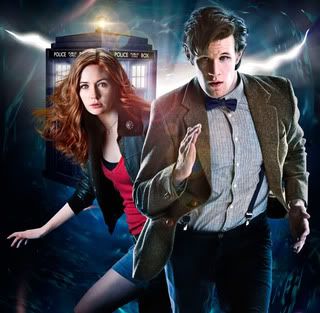
Doctor Who series five ended last Saturday and I’ve been rewatching some key episodes of the season including opener The Eleventh Hour and the final two parter The Pandorica Opens and The Big Bang. So I thought I’d give a summary of my thoughts on this brand new regeneration of the classic and much loved series.
As Doctor nine would say: ”Fantastic!”
I get Steven Moffat's approach to Who. Because it's the same one I have. It hits all the right buttons for me.
This season was a twisty crazy fairytale all about little Amelia Pond and her imaginary friend, a madman with a box who fell out of the sky.
"When I was seven I had an imaginary friend. Last night was the night before my wedding, and my imaginary friend came back."
While left all alone one night, a brave little girl called Amelia prays to Santa for someone to come and save her from the scary crack in her bedroom wall. And come to her someone does, falling right out of the sky and in to her garden. The Raggedy Doctor. A brilliant yet strangely childlike madman with a box who eats fish custard and loves bowties and thinks fezzes are cool. But after fixing the crack in the wall, The Doctor disappears leaving poor little Amelia all alone once more. But she refuses to give up on him and settles down to wait for his return. And she waits and waits and waits. Little Amelia eventually grows up to believe that she imagined it all, that nothing that happened that night was real, that the Raggedy Doctor never existed. The wonder, the magic, the imagination of childhood has finally been driven out of her. She loses herself, her innocence, even losing her name, now being called Amy. As an adult she becomes cynical, rather bitter and hard nosed - albeit charmingly so.
And then one day, many years later, right out of the blue (box), her imaginary friend returns.
The story of Doctor Who season five is not so much about hanging on to the wonder and the imagination of childhood as it is about regaining it once lost. It’s about losing our cynicism and finding the simple joy in everything that is out there beyond the narrow, repetitive often soul-destroying confines of adult life. Now, most of us (I certainly do) remember how when we were kids we could happily play for hours, imagining all sorts of weird and wonderful adventures to lose ourselves in. We didn’t need much, just our imagination and the freedom to disappear within it. But there comes a point – maybe around age eleven or twelve – when that ability starts to fade. It gets harder and harder to have imaginary fun in our own little worlds, fun that once felt so easy, so real. The magic of childhood starts to leave us as we begin the difficult journey in to adulthood, having to spend more time thinking about real life because real life has suddenly become far more complicated and far more necessary as more demands are put on us along with more responsibility.
But the good news is that just because we become adults with all the baggage that brings, we can rediscover our imaginations. We can learn to see with more innocent, wondrous eyes again. We can rediscover our inner child so to speak. That is exactly what happens to Amy. By seasons end she has found little Amelia. Literally. The Doctor was the key to her re-discovering her inner child, her sense of adventure, discovering the weird, crazy, silly, scary fun that life can be.
The Doctor: “Fourteen years since fish custard. Amy Pond. The girl who waited, you've waited long enough.”
Amy: “When I was a kid, you said there was a swimming pool. And a library, and the swimming pool was in the library.”
The Doctor: “Yeah. Not sure where it's got to now, it'll turn up! So! Coming?”
Amy: (shaking her head) “No.”
The Doctor: “You wanted to come fourteen years ago.”
Amy: “I grew up.”
The Doctor: “Don't worry. I'll soon fix that.”
This season has been my favourite of new Who so far. And that’s due primarily to its thematic undercurrent, one which chimes perfectly with what I love most in storytelling - the fairytale vibe, the innocence and wonder and scariness of childhood and of life in general. It’s what Spielberg has been doing for years. And it works for a reason. The same reason it has worked down through the centuries. It imparts important stories and lessons to children while also reminding adults what it is like to be a child, reminding us not to lose that special gift that lets us make up crazy adventures and weird and wacky stories in order to pass on down to our own children the same important messages and themes.
I love this season for its range of stories too, and that while shifting from the more overblown, camp, panto feel of Russell T Davies’ tenure to Steven Moffat’s more odd, sinister, eccentric fairytale feel, Doctor Who hasn’t lost its sense of fun nor its crazy, silly, very British whimsy. The stories this year have ranged from the downright nightmarish (The Time of Angels) to the very silly (Victory of the Daleks) to the emotionally sublime (Vincent and the Doctor). And throughout it all, Matt Smith has been a total legend and has made The Doctor his own. I liked Tennant, though I much preferred Eccleston, but Matt Smith has trumped them both. His energetic, clumsy, rather mad little old man in a young man’s body has been a joy to watch. And I love Amy too. Like many men I am in lust with Karen Gillan. She is great and has such a wicked chemistry with Matt that just crackles both onscreen and off. And she had to be great because this season was Amy’s story. It was the story of little seven-year-old Amelia Pond, the girl who waited. The girl who grew up, but who then became a child once more. Brilliant!
Any negatives? Well, my only real problem has been with some of the FX. There’s been some pretty shoddy CGI in places. So, please, someone give the guys at The Mill a kick. They do some great stuff (the two-part finale FX are all pretty darn excellent) but then they seem to counter it with some truly ropy stuff. A bit more quality assurance needed me thinks.
Anyway, this has been a wonderful new start for The Doctor with Steven Moffat proving yet again why he is such a genius of a writer and one of the very best working in the industry today. Everything in this season was thought out and planned in detail. Things are set up and pay off throughout – both plotwise and thematically. It’s an intricate machine of storytelling, which ends with the sublime two-parter of The Pandorica Opens and The Big Bang. And, of course, with season five a star has been born in the form of Matt Smith. So roll on the Christmas special.
"Geronimo!"
Tuesday, 25 May 2010
R.I.P. Lost
(Sorry about the Radiohead song)
*SPOILERS*
Okay, so the last ever Lost was an emotional experience.
I don’t care what some critics or disgruntled fans say…
It was brilliant!
To my mind the people who didn't like it just didn't understand it and hadn't really been paying as close attention to the show all these years as they probably thought they had. So, for all you pissed off knuckleheads, here’s a wakeup call…
Ladies and gentlemen...Lost was NOT a show about plot.
Like all the best meaningful storytelling, Lost was about something more. It wasn't really about twists and turns and polar bears and smoke monsters and hatches. All of that was just surface mechanics designed to keep the real story powering along in order to get the characters where they needed to be and to help play out the ideas and themes underpinning everything. No, Lost was a show about a core group of interesting, compelling characters who had all become lost in life somehow. It was a show about meaningful and timeless themes with the likes of faith, destiny, redemption, finding ones place in the world and finding a purpose in life being amongst the strongest. And to my mind it all paid off handsomely. The Island and the Light were, in the end, just macguffins to get that particular group of people to where they all finally needed to be. Together. I admit it. I was tearing up at the end. It was sad yet also incredibly joyful to watch this series boiled down to its most basic idea, an idea brought to such a beautifully told conclusion.
Ultimately Lost was a very human and a very spiritual (not religious) show that tried to give its viewers a taste of something a little bigger and a little more hopeful without ever being overly sentimental or obvious. It was always exciting, always challenging, always ridiculously compelling and always, always utterly unmissable. And in the end, it gave us something else too. It gave us sight of something more: an end and a beginning together with those who mean the most to us. Something I wish with all my heart to be true.
For a great summary of what Lost and its finale was all about, click the following link written by an alleged writer on the show. Even if he/she wasn't really a writer on the show, it is still insightful stuff.
http://designwoop.com/2010/05/lost-finale-explained-well/
So long Jack, Kate, Sawyer, Hurley, Libby, Locke, Jin, Sun, Sayid, Claire, Charlie, Desmond, Juliet, Ben, Boone, Shannon, Rose, Bernard. It’s been a privilege knowing you all.
Sunday, 4 April 2010
Trust Him. He's The Doctor.

Matt Smith's debut as The Doctor has now aired in the UK.
And I gotta say...it was brilliant!
Steven Moffat's rejuvenated Who is (pardon the pun) just what The Doctor ordered. The tone is indeed like Moffat’s promised dark fairytale - especially the first ten minutes or so of this Moffat written story titled The Eleventh Hour. This episode charts the first and then second meeting between the new Doctor and his new companion Amy Pond. And this meeting is quite special, clever and touching.
So, most importantly, how is our new Doctor?
He's great.
Being still in the grip of his regeneration cycle Smith's Doctor is rather confused, manic, and still a bit Tennant-y in his ways. But as the episode goes on he slowly becomes more of his own man. Eccentric in a young-yet-old professor-ish way, he is also effortlessly witty, a bit goofy, a bit reckless and quite a lot charming. Smith's Doctor makes an instantly great impression. The food tasting scene with the little girl in the kitchen is simply brilliant. “Fish Custard.” LOL. You can see why Smith leapt out at Moffat and co. during auditions. He genuinely does have an odd, otherworldly quality to him. And as new companion Amy Pond, Karen Gillan is very good too. In this episode she is all (lovely) legs, fiery red hair and cynical attitude. She’s a bit messed up, a bit of a bad girl and doesn’t really trust The Doctor and isn’t afraid to give him what for. She is also very, very easy on the eye. Amy and The Doctor should prove for an interesting and fiery dynamic with their relationship having been set up in a very cool and intriguing way.
And the story? It’s fine. It does the job. An escaped intergalactic shape-shifting alien prisoner is hiding out on Earth while the Prison Guards (giant flying eyeballs) arrive to give the world only twenty minutes to hand the prisoner over before they destroy the whole planet. As a story it’s not as good as what Mr Moffat has given us before (we’ve been spoiled) and he uses it mostly as a hanger for introducing the new Doctor and the new feel to the series as well as reminding us of its mythical heritage. And in that way it works spot on. But Moffat still manages to do what he always does so brilliantly. He layers his script with smart precision plotting and intensely creative ideas while also inventing scary images and creepy concepts based around things an audience (especially kids) can relate to as being odd and kinda disturbing at a very basic level. At night a big crack in the wall of a child’s bedroom becomes sinister and so very creepy with whispered voices leaking out. A bleak phrase is repeated over and over through every piece of electronic communications equipment everywhere. Extra rooms in a house seem to appear but are only visible glimpsed through the corner of the eye. An alien changes itself to appear as regular people but gets it a bit wrong, appearing as a mother walking hand in hand with twin little girls, except the children speak with the mothers voice and vice versa. And it also appears as a man walking a dog, but the man barks and growls, not the dog. Weird and properly creepy. And Moffat being Moffat he also laces his script with some great quips and one liners. “You’re Scottish. Fry something!” The direction of the episode is excellent too. There are two stand out moments: a glimpse in to The Doctors mind as he recalls an event that has just occurred, looking for a clue in his own memory. Then, later on, glimpses of all past ten Doctors ending with the heroic emergence of Doctor number eleven to confront the bad guys. Also, the first ten or so minutes of the Doctor crashing the TARDIS and meeting a little girl left alone in her house and scared by the sinister crack in her wall is just all-round superlative. A very special shout out goes to young Caitlin Blackwood who plays said little girl. She is wonderful and does a quite brilliant job opposite Matt Smith.
As well as a regenerated Doctor, the rest of the show has had a ground up regeneration too. There’s a new title sequence with a dark and scary time tunnel complete with lightening bolts striking the TARDIS. And there’s a new, more electronic and choral version of the iconic theme. The TARDIS has also regenerated after being almost wrecked at the episode’s start. It looks newer and brighter outside while inside the console room is twice as big and on multiple levels with curved and odd-angled walls and with stairs going off in many directions. It looks weird and very, very cool.
So colour me impressed. I could tell within the first ten minutes that I loved this new take on our favourite Timelord, it being much closer to my own personal tastes than that of RTD’s version. Not to take anything away from the awesome job Russell T did, but I just love the whole dark fairytale vibe, the more sinister-yet-playful feel. And I can see a whole new generation of kids properly hiding behind their couch come Saturday evenings as a result. And their parents might just be joining them.
So bring it on. And like the man says: “Trust me. I’m the Doctor.”
Indeed you are, sir.
Sunday, 14 March 2010
A Legendary Book

I am Legend (Richard Matheson, 1954)
This month I finally got around to reading Richard Matheson’s 1954 sci-fi/horror classic I am Legend. It’s one of those books I’ve been meaning to read for years as it’s had such a major impact on modern sci-fi and horror movies and literature. I’ve seen the three films based on it - The Last Man on Earth (1964) starring Vincent Price, The Omega Man (1971) with Charlton Heston and, of course, I am Legend (2007) starring The Fresh Prince and a dog. Even before reading the book I didn’t much like any of these films with the exception of The Last Man on Earth, which, though very low budget, at least seemed faithful and starred the great Vincent Price. I really do hate The Omega Man what with its trippy albino hippies while I am Legend is a decent enough blockbuster vehicle for Will Smith but I knew even before reading the book that it missed the whole point of Matheson’s story by going all CGI Hollywood on us.
For those who don’t know the story of the book, it goes like this:
A plague has swept across the world killing most of humanity and turning them in to vampires. The ones it has infected but who haven’t died have also become vampires. As such the main character Robert Neville appears to be the last human left on Earth.
Neville spends his days out of his fortress house gathering supplies and finding the living and the dead vampires and staking them for a final death. By night he holds up under siege from a horde of bloodsuckers led by one time neighbour Ben Cortman who desperately wants to get at Neville, hurling abuse and taunts at his home guarded by garlic and crosses – all of which seeming to work in the traditional way. Neville has lost his wife and young daughter to the plague and so spends a great deal of time in depression and in heavy drinking. His loneliness is always threatening to destroy him faster than any vampire could. He spends a couple of years this way until he eventually discovers a new mission and point to his life. He decides to learn about diseases and germs and sets out to discover the true source of the vampire plague. He also wants to find out how come all the traditional vampire lore seems to be true – sunlight killing them, fear of crosses, repelled by garlic, unable to cross running water, killed by a stake through the heart. And, of course, how come he alone seems immune.
I am Legend is a fascinating tale that works on several levels.
Firstly, it takes the familiar folklore of vampirism and treats it as a disease; a natural based condition rather than a supernatural one. Over time, Neville does indeed identify the cause of the plague and discover the scientific based reasons for all the familiar vampire attributes. Some of which are surprising but do make a weird kind of sense and are backed up by reasoned arguments. To my knowledge this is probably the first time this approach to vampires was ever taken. Nowadays we see it a lot with the likes of Blade, Ultraviolet, Underworld and the recent Daybreakers, that last one owing a huge debt to Matheson.
Secondly, the book works as a character study. It’s a dark and tragic tale of loneliness, isolation, guilt and regret. Neville feels constant guilt over the death of his wife, Virginia, whom he loved intensely. We see some of their life together in flashback including when she first became ill. And we also see in flashback the horrific night where she comes back to him as a vampire and what he then had to do. Neville of course feels guilty about having had to kill Virginia as a vampire, but more so about having survived the plague while she didn’t. Throughout the book he is constantly talking to her, either out loud or in his mind, saying things like “I’ll be with you soon, Virge.” Neville often falls in to deep depressions, losing track of time and of himself, resulting in sudden mortal dangers such as being caught outside for too long as the sun falls and the vampires come out to hunt. He is also constantly reminded of his old life by the nightly appearance and taunting from his old friend and neighbour Ben Cortman. One of the most interesting things in the book is the sexual nature of Neville’s guilt. Because he is all alone and still has the normal male urges, he finds himself aroused by the female vampires who come out at night and display themselves to him, trying to lure him to them. This is a familiar theme in vampire stories: the sexual undercurrent including dangerous sexual temptation. And Neville hates himself for the thoughts that go through his head and the reaction his body has to their offered flesh. More than once he almost gives in and goes to them, but manages to pull back at the last moment.
Thirdly, I am Legend works as a morality tale. A fable about ones place in the world. About seeing the wider view and not giving in to mindless fear and prejudice, about trying not to become that which you despise the most. For it eventually becomes apparent to Neville that the world has changed forever. There is no going back. Humanity as he knew it has gone, with a new species now born in its stead. A species that is trying to carve out a new society from the ruins of the old. But one thing stands in their way. The one who murders their kind by day, slaying loved ones – mothers, fathers, husbands, wives, children. The object of their fear and hate, the bogeyman that comes for them while they sleep. There is only one way this story can end.
I am Legend is a great book, a justifiable classic. It is short (180 pages), simply told, lightly plotted, yet dense with ideas and character. Neville is an everyman. He is not a soldier or scientist or whatnot. He is smart and resourceful, sure, but he also has to learn about things to survive and progress. He spends years learning about diseases and germs so he can try and work out what happened to the world. Even then he gets things wrong.
Having now read the book, the Vincent Price movie is by far the closest in terms of plot and themes. The Will Smith one is pretty far removed and it irks me even more that they took a book full of such great ideas and a brilliant and challenging central one (which is the entire point of the book’s title) and discarded it in favour of standard Hollywood heroics. They entirely missed the point of Matheson’s story. Twats! Reading I am Legend I couldn’t help but think that back in his heyday John Carpenter could have made a wicked film out of it. Shame he didn’t get the chance.
But if you ever get the chance, then pick up a copy and read it. It’s a seminal work. It’s the stuff of legend.
Next up on my book pile is Handling the Undead, Swedish writer John Ajvide Lindqvist’s follow up to his excellent Let the Right One In.
Subscribe to:
Posts (Atom)